Translation – Exercise 04 (10%)

translation Final ex04 sarah and andrea from Andrea Thiele on Vimeo.

Rationale

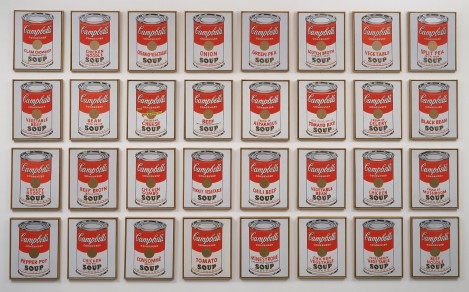
The selected artwork we chose to translate into video was Andy Warhol’s Campbell’s Soup Cans. Warhol was an American Pop Artist who appropriated images from consumer culture and made it art. We thought it would be interesting to take one of his iconic paintings and do the same thing he did – translate it into a different medium for a new perspective on everyday objects.
Warhol.-Soup-Cans-469x292.jpg

Picture above entitled: Campbell’s Soup Cans by Andy Warhol

Image and info source: https://www.moma.org/learn/moma_learning/andy-warhol-campbells-soup-cans-1962/

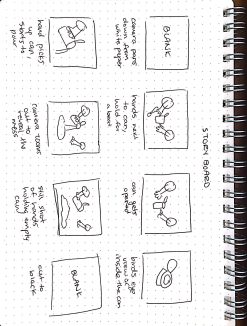
We intentionally wanted to replicate the background of the white canvas, therefore we used a large blank piece of paper and cut out arm holes. Furthermore we wanted to play with the 3D object of the can, and capture what shadows it casts and the form it takes when placed against a solid white backdrop. The hands and the can interact and perform a task while the camera moves to show different angles of the can. The expectation established at the start of the video is to open the can and the resolution is that the can gets opened and the contents gets poured out. We wanted the audience to feel slightly shocked and uncomfortable, by the random hands not attached to a body as well as the act of pouring soup all over the table.

Visual Script
unnamed.jpg

Individual Reflection

Our intention was to take the ordinary yet iconic tomato soup can and change the audiences expectations of what a normal interaction with a normal object could be. The ending was meant to be a surprise or a plot twist. It was difficult to keep the background a solid white colour as to not distract from the can itself, while still maintaining movement with the camera. The decision to cut holes in the paper was a good idea yet failed in practice as the holes were slightly too large. Also as we were limited to just a can of soup, we wanted to add a can opener. However we did not open the can during the video as it took much too long. In the end I feel as though the video gave off the impression we wanted while still having roots in Warhol’s iconic painting of the can of soup itself.

Sound Essay: Ex 03 (10%)

object word: work

transformative words: burst, eliminate

This audio file starts with a burst of energy, an idea or thought that pops into ones head when starting a new project. Then it becomes a process of elimination, scribbling out the bad ideas, deleting, backspacing, crumpling up paper, sighing, sipping coffee. The creative process is frustrating especially if your idea is great in your head but on paper it is not coming out right. I tried to capture that feeling in audio form.

Listening and Sound Journal

“Staircase” (indoor) – I sat on the staircase in the DB building by the bathrooms on the first floor. The sounds were echo-y and overall quiet. Time, 2:45pm Monday sept 24 2018.

N: I did not hear any natural sounds as I was indoors.

M: air conditioning (loudest), bathroom/running water from the tap, door hinges creaking (quietest).

P: stepping, shoes squeaking, stomping, hands sliding down the rails (most memorable), soft voices.

The moving sounds were: people walking, stepping and talking while getting farther away. The stationary sounds were: the air conditioning and doors opening/closing.

“11 Degrees” (outdoor) – I sat near the Starbucks on a picnic table. The sounds were loud and constant. Time, 2:55pm Monday sept 24 2018.

N: leaves rustling, wind, trash blowing on ground (quietest), birds (most memorable).

M: doors opening and slamming shut, cars, music with heavy bass in cars.

P: talking, laughing, wheels on rolling backpack on bump surface (loudest).

The moving sounds were: people talking, trash blowing, wheels from backpacks/cars. The stationary sounds were: wind, leaves on trees, doors.

What are the special sounds in space 2 and how do they compare to the space 1?

Space 1 was very empty sounding thus creating echos whereas space 2 was very active with many sounds overlapping.

How do certain sounds adapt to the outdoor and indoor spaces?

I heard talking in both spaces and inside I could hear the conversations very clearly but outside I could only hear the sound of voices, not what they where saying.

Can you define a sound identity of these different spaces?

Indoor – sheltered. Outdoor – energetic.

Design Journal #1 Sept 13 2018

This week I came across an article on the different styles and techniques used when setting up a shot for film or photography. After completing my first in-class exercise focusing on framing and light duration, I wanted to learn more on how to properly set up a good looking frame to get the best shot possible.

The article discussed 20 composition techniques along with examples. I was shocked at how many different ways there are to set up a frame, and how the person behind the camera has to pay attention to everything in the shot. The lines, the textures, the patterns, the white space, the colours – it all matters when planning a good composition.

Before reading this article I only knew about “the rule of thirds” but there are so many more techniques and guidelines to keep in mind for the next exercise I do. I found the “frame within a frame” technique very visually interesting and I hope to apply it to a future Time Based Communication project.

Light and Duration (5%) Exercise 1 – Andrea Thiele and Sam Hansel

Watch the Video Here

A small critique of my work – I feel very good with the outcome of this exercise and how well it captured subtle movement/changes in light. It was a difficult location to find and we had to shoot through a window thus making the focus of the camera shift during some images, unfortunately. I am proud of how consistent the framing was and overall I am happy with the result.